Rong Kit
The Kui body scrubber
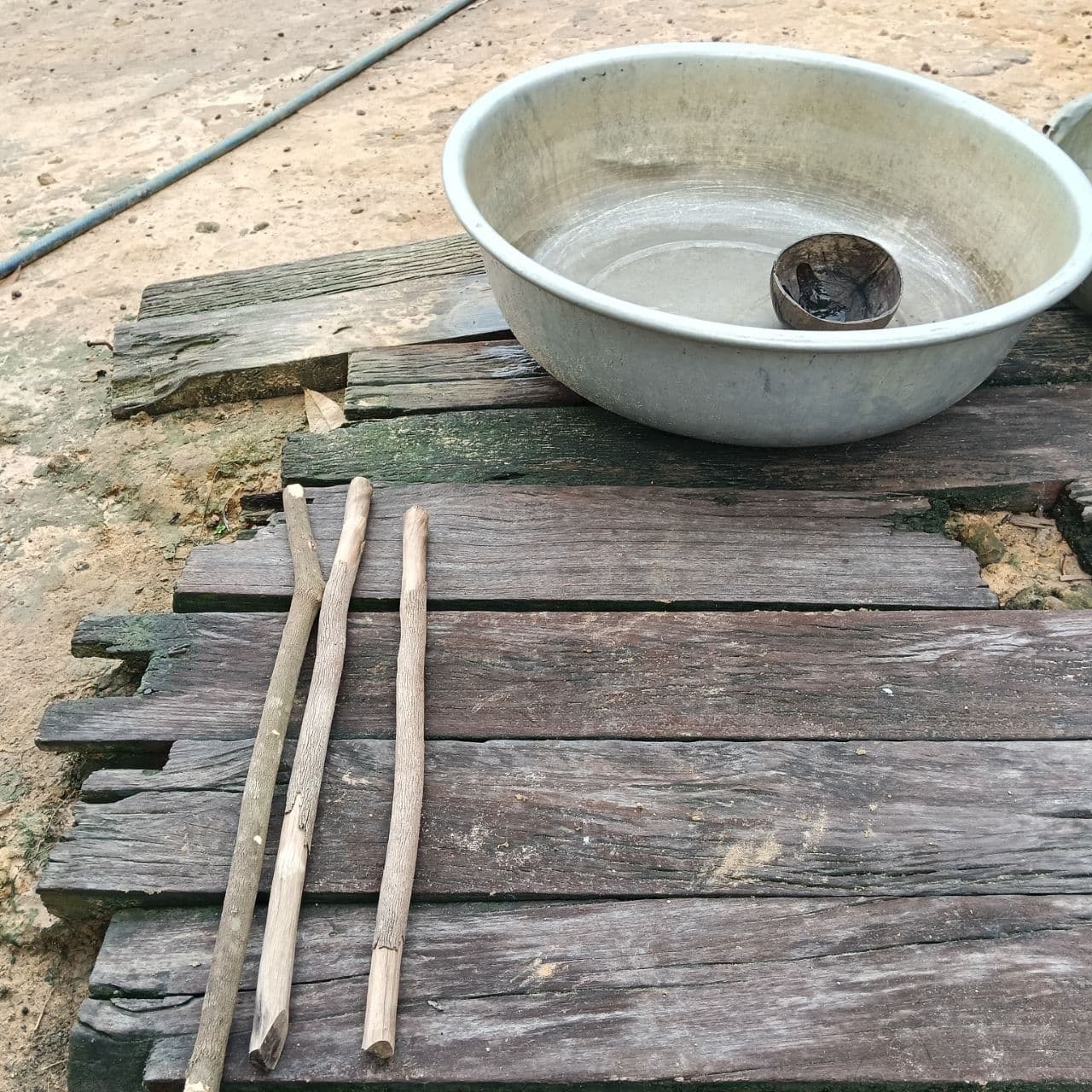
រង្គិត (Rong-Kit) is a Kui word that refers to a piece of wood, approximately two arm-spans long, which extends beyond the back. This wood is used to scrub off dead skin or dirt on the skin when bathing. The use of the Rong-Kit is currently observed in some families of the Kui indigenous people in the provinces of Kampong Thom and Preah Vihear.
According to the account of Ms. Proum Eam, a 75-year-old Kui elder in Andas village, in Kampong Thom province, the use of this Rong-Kit has been passed down through generations since the time of her grandparents. She further stated that the wood used to make the Rong-Kit is from the Phlong tree, which grows in the forests on hilly terrain, mixed with other types of trees. This tree is chosen because its bark is fine, with small patterns or grain, which allows it to effectively scrub and remove grime from the body.
The Phlong tree used must be an old, straight trunk with good bark, free of branches or knots. Its thickness is about the size of an adult's big toe or a young child's wrist (3-4 years old). Older wood is preferred because it lasts longer and the bark does not easily peel away from the core wood. Regarding the process of cutting the Rong-Kit, she explained that generally people do not go out just to cut the Rong-Kit alone, or only when they need it immediately. They go out to the forest when they are clearing the fields together (ael-tei / yok dai - a form of communal work very important for Kui culture), herding cattle or foraging for forest by-products, such as harvesting vines, rattan, resin, etc.
When they encounter a good Phlong tree that can be made into a Rong-Kit, they cut it then and there (a single tree might yield one, two, or three Rong-Kits, depending on its quality) so to be stored for later use. People mostly store it on a rack under the house to prevent the bark from being quickly damaged.
She added that this is why they often say, "Jey Koh" (go to the forest), a phrase with a very broad meaning. Because when entering the forest, people do not go empty-handed; men may carry a knife, a machete (phgak), or a hand-hoe (kajas), while women may have a krama (Cambodian scarf), a hand-hoe, a knife, or a hoe (job jik). When they encounter any issue, they have tools for self-defense, or they take whatever they can bring home such as picking vegetables, fruits, chopping firewood, digging up yams, and even tarantulas (a-ping)! In short, any forest product that can be locally consumed.
How to Use:
When bathing, it is used to scrub the body to remove dirt and grime, particularly for scrubbing the back, elbows or knees, and it can be used by people of all ages. After use, it is left in the bathing area, as a single Rong-Kit can be used for three to four months, being replaced when the bark wears down and loses its texture. It is not strictly personal; a family with four or five members may use two, three, or four Rong-Kits communally. Also, the Rong-Kit can be used immediately after being cut; it does not need to be dried or seasoned first.
Current Usage:
However, the number of families using the Rong-Kit today is dwindling. This is due to the evolving lifestyle of the Kui indigenous community becoming more modern, replacing the Rong-Kit with body soap (especially since 2000). Furthermore, the presence of the Phlong tree is also decreasing as natural forest land is converted into cashew, cassava or rubber plantations by outsiders and private companies
Nevertheless, the elders still use the Rong-Kit in conjunction with soap, especially finding it easier for scrubbing their backs. All of this demonstrates the evolution of culture, the environment, and people through the passage of time.